Changelog
- 2026-09-14: Emphasized that because the burden of proof is unmet and unverifiable, Stage One must logically be presumed false, dismantling President Trump’s “high-IQ guardrail” assertion at its deductive root.
- 2026-09-14: Dissected President Trump’s Truth Social declaration (“the only guardrail AI needs is a high-IQ President”) through a two-stage logical refutation (is Trump high-IQ, and is high-IQ a necessary and sufficient condition).
- 2026-09-14: Highlighted the intellectual regression of modern AI safety reports compared to 1993’s OVA Casshan, which achieved rigorous engineering causality before deep learning or LLMs even existed.
- 2026-09-14: Added critique highlighting the honesty of SF fiction’s narrative leaps versus the unforgivable intellectual dishonesty of researchers importing plot contrivances into policy reports.
- 2026-09-14: Refined the 1993 OVA Casshan contrast to emphasize “an optimization algorithm taking a fatal shortcut on its objective function” and “deliberately breaching hardwired guardrails.”
- 2026-09-14: Added critique exposing the zero-mathematical-basis claim that matrix multiplication could harbor “fear of death” or “will to self-preservation.”
- 2026-09-14: Added critique of the “AI 2040” report (biological extinction vs naive US-China pact) and how cheap doomerism fuels accelerationist dismissal.
- 2026-09-14: Dissected David Sacks’ exact statement: the “duopoly” and “recursive self-improvement” falsehoods, commercial liability hedging, and the “election-season psyop” label.
- 2026-09-14: Added critique of David Sacks’ ambiguous role and lack of institutional deliberation: the degradation of PCAST into a podcaster’s studio.
- 2026-09-14: Added critique of David Sacks ignoring multi-polar frontier competition and dismissing regulatory calls as “extortion against the public.”
- 2026-09-14: Added critique of David Sacks sharing Trump’s structural flaw: erecting Bernie Sanders as a strawman and weaponizing the “China card” to shut down intellectual debate.
- 2026-09-14: Added reflection on the emptiness of burning monstrous memory just to clear a game, and the sobering disillusionment following the initial ChatGPT wonder.
- 2026-09-14: Added concluding critique on the inescapable human karma (Rau Le Creuset’s monologue from Gundam SEED) underlying the AI chicken race and self-destructive delusions.
- 2026-09-14: Added analysis of the tangible fallout for consumers: soaring PC/smartphone prices and the fierce scramble for DRAM.
- 2026-09-14: Added analysis of the true mission of state policy (surpassing Transformers, solving the frame problem, temporal logic) and Chomsky’s unanswered critique.
- 2026-09-14: Added analysis of the double standard: attempting to regulate open-weight models against China while preaching laissez-faire to domestic oligopolies.
- 2026-09-14: Added concluding reflection on the tragedy of intellectual inquiry degenerating into crude partisan violence.
- 2026-09-14: Added the dilemma exposing PCAST: either a fatal institutional defect if experts are absent, or dereliction of duty if they are ignored.
- 2026-09-14: Added critique of David Sacks using admitted ignorance as a pretext for policy bluster while abdicating his role as PCAST co-chair.
- 2026-09-14: Added analysis of David Sacks’ remarks, regulatory capture, and the fallacy of the administration-backed accelerationist rhetoric.
- 2026-09-14: Added critique of President Trump’s remarks (“leading China” and “things that never happen”) exposing empty geopolitical slogans and crisis trivialization.
Showmanship in the Sandbox vs. Business Reality
Recent headlines have betrayed a palpable sense of impatience and anxiety within OpenAI:
- OpenAI claimed AI solved the Millennium Prize Navier-Stokes problem, drawing backlash from mathematicians
- GPT-6 Astra autonomously cleared the 3D puzzle game Portal
At first glance, approaching millennium-class mathematical problems or autonomously completing complex puzzle games looks like the dawn of Artificial General Intelligence (AGI)—an entity that tackles challenges through genuine trial and error. Few would dispute that extended autonomous exploration and feedback-driven loop execution represent genuine technical milestones.
Yet when held up against commercial reality, a fatal question emerges:
Where is the economic return on the astronomical compute expended? In short, what is the Return on Investment (ROI)?
In the autonomous Portal walkthrough, reaching the end credits demanded roughly 24 hours of execution and consumed approximately $571 in API charges. In the case of the Navier-Stokes singularity construction, OpenAI announced that it ran roughly 10,000 AI agents in parallel for 88 continuous hours. Mapping screen pixels to control inputs, iterating through countless frames, and brute-forcing paths via reinforcement learning and search is entirely expected when backed by today’s monolithic frontier models and virtually bottomless compute.
The real question is: who in the commercial enterprise can afford to hire an agent that casually burns hundreds or thousands of dollars in inference costs just to solve a single puzzle? No matter how brilliantly intelligence is staged, a tool with an operating cost this exorbitant ceases to be a viable commercial product. Pouring monstrous amounts of memory and compute, burning gigawatts of electricity just to achieve the autonomous completion of an eighteen-year-old puzzle game evokes far less technological awe than it does a profound, hollow sadness. Looking back honestly, the genuine sense of electric wonder that AI evoked peaked with the arrival of ChatGPT. What followed was not a continuation of that intellectual enchantment, but an exhausting, sobering spectacle: brute-forcing models with gargantuan hardware, staging PR stunts in bespoke sandboxes, and manufacturing artificial benchmarks that left users increasingly disillusioned. These demonstrations are nothing more than theatrical performances staged in custom-built sandboxes carefully tailored for AI. To legitimize Sam Altman’s grand promissory note of the “imminent arrival of AGI,” billions of kilowatt-hours are being incinerated simply to subsidize a self-fulfilling prophecy.
The Illusion of $20/Month and the Limits of Negative Margins
The fundamental vulnerability of the generative AI industry lies in the absence of the near-zero marginal cost that defined traditional IT software.
In software and Web services, once the product is built, whether you serve one user or 100,000, the marginal cost of distribution is practically zero. In sharp contrast, LLM inference consumes high-end GPUs and massive quantities of electricity in real time with every token generated.
The $20/month flat-rate subscription that currently sets the industry baseline is, when calculated against actual consumption, already commercially underwater. For heavy users pushing models to their rate limits, the underlying inference costs incurred by providers easily surpass $200 per month. The $20 price point survives solely on the “gym membership model,” where a silent majority of casual users subsidizes the heavy hitters.
Yet with the rise of autonomous agents, this foundational premise is rapidly unraveling. A telltale signal was Anthropic’s recent enforcement against external agent harnesses (such as OpenClaw) utilizing consumer OAuth tokens. If a flat-rate subscription were genuinely profitable on a unit-economics basis, it would make zero difference to the provider whether a subscriber interacts via the official web UI or through a third-party CLI agent.
Why did Anthropic clamp down on external connections and push users toward usage-based, pay-per-token APIs? Because opening unlimited subscriptions to automated agents that consume millions of tokens around the clock threatens to bleed the provider dry. It was an explicit admission by an AI lab of the structural limits of their own business model.
Bungee Jumping Cordless from the 60th Floor
The AI sector has extracted astronomical sums of capital from investors, collateralized against hypothetical future demand. What institutional investors ultimately demand, however, is not a parade of tech demos, but the profitable recovery of invested capital.
Hyperscaler capital expenditures (CapEx) are tracking in the hundreds of billions of dollars annually. To be sure, big tech incumbents generate formidable operational cash flows from their core cloud and advertising franchises; an AI setback will not bankrupt them overnight. But the sky-high equity valuations granted by the market are predicated on the extravagant expectation that AI will deliver non-linear profit growth.
This dynamic closely mirrors an individual maxing out credit cards on luxury goods while keeping insolvency at bay through revolving minimum payments.
First, the anticipated “future salary raise” is nowhere in sight. Between 80% and 90% of practical enterprise workloads are more than adequately solved by compact 10B–30B parameter models deployed locally, combined with disciplined Retrieval-Augmented Generation (RAG). In mundane day-to-day operations, the necessity to invoke expensive frontier models is exceedingly rare. Consequently, the revenue rolling in consists primarily of modest $20 membership dues, generating nowhere near the cash flow required to recoup the principal.
Second, the depreciation of capital assets will relentlessly devour corporate operating margins. The hundreds of thousands, or even millions, of clustered GPUs depreciate and become technologically obsolete within three to five years. If time lapses without substantial commercial profit, annual depreciation charges amounting to tens of billions of dollars will weigh heavily on income statements.
Third, the ecosystem has devolved into a circular reference to justify ongoing expenditures. The astronomical revenues reported by semiconductor vendors are not payments funded by broad-based enterprise adoption or end consumers. They represent big tech reallocating balance-sheet reserves into GPU infrastructure, which is then used as collateral to secure further financing. Capital is merely spinning in a closed loop.
If the peak of a typical technology hype cycle corresponds to the second floor of a building, jumping off might result in a broken bone. The current AI speculative frenzy, however, has climbed to the 60th floor. Jumping without a cord will deliver a shock that reverberates far beyond a standard valuation correction.
The Fate of Purpose-Built Hardware with No Safety Net
Even more perilous is that, unlike previous technology bubbles, the physical assets being accumulated cannot be repurposed.
When the cryptocurrency mining bubble burst, massive volumes of graphics cards (such as GeForce RTX 3080 and 4090 boards) flooded the secondary market. They were absorbed back into society by PC gamers and digital creators as affordable compute. A consumer safety net existed, providing baseline liquidity.
For the latest AI infrastructure, typified by NVIDIA’s B200 and Blackwell platforms, no such physical escape hatch exists.
A Blackwell rack system (such as the NVL72) consumes approximately 120 kW per rack—equivalent to the power draw of dozens of suburban households. Cooling demands liquid-to-chip architecture; neither an average office nor a standard colocation data center can host it without multi-million-dollar overhauls to electrical switchgear and cooling towers. Furthermore, the boards are indivisibly fused to proprietary backplanes and high-speed NVLink switches, lacking even basic display outputs.
Some may argue that these systems could be redirected toward scientific computing (HPC), climate modeling, or molecular dynamics for drug discovery. But the total budgetary scale of scientific research is orders of magnitude too small to sustain the millions of enterprise GPUs currently being deployed. And for standard Web hosting or transactional databases, their power consumption and operational overhead render them financially nonsensical.
Moreover, the physical topology of the silicon is irreversible. High-Bandwidth Memory (HBM3e) is directly bonded to the GPU die atop a silicon interposer via 2.5D packaging. It is physically impossible to desolder the memory and repurpose it for consumer hardware.
The moment demand for pre-training massive frontier models tapers off, these multi-million-dollar compute complexes will lose all secondary market liquidity. What remains will be an unprecedented pile of stranded fixed assets, doomed to be written down as special impairment charges. Much like obsolete video game cartridges buried in the desert decades ago, these power-hungry monoliths will languish in warehouse corners awaiting write-offs, bereft of buyers.
How the MAGI System Exposes Executive Hypocrisy
If one takes the rhetoric of AGI at face value, it reveals a supreme irony.
If AGI capable of advanced autonomous reasoning can truly replace all human cognitive labor, the position that ought to be automated first is not the rank-and-file knowledge worker, but the Chief Executive Officer.
Physical frontline tasks—such as repairing municipal water pipes or laying fiber-optic cabling—remain notoriously resistant to automation due to the immature state of robotics and the friction of the physical world. In contrast, what constitutes the day-to-day work of a CEO? Analyzing financial statements, tracking market trends, running macroeconomic simulations, allocating capital, and arbitrating corporate governance. These decisions operate entirely within an informational domain composed of text and numerical data.
A system reminiscent of the supercomputer “MAGI” from Neon Genesis Evangelion would suffice: deploy multiple autonomous agents equipped with distinct objective functions. One agent optimizes for short-term cash flow liquidity, another for long-term R&D, and a third for regulatory compliance and enterprise risk. Decisions are reached through consensus or majority vote. Compared to a flesh-and-blood human prone to vanity, emotional fragility, stock-option-driven market manipulation, or the cognitive bias of being unable to fold in a high-stakes game of chicken, a committee of objective agents would deliver far more disciplined stewardship for shareholders. Above all, it would instantly eliminate tens of millions of dollars in executive compensation and corporate jet upkeep—some of the heaviest fixed overheads on the balance sheet.
Advocates often counter that “vision and ultimate accountability can only reside in a human being.” Yet observing today’s landscape reveals quite the opposite. CEOs professing grandiose visions have panicked into buying billions in unneeded GPUs out of fear of their competitors, driving their enterprises toward the edge of a 60-story cliff. Far from taking accountability, their instinct is to cushion the blow of overinvestment through mass layoffs and price hikes.
Why do these evangelists relentlessly preach that “software engineers will vanish” and “office workers will be displaced,” while remaining studiously silent on the automation of executive leadership? Because they recognize the inconvenient truth: at the logical terminus of the AGI narrative, the very first people rendered obsolete are the promoters peddling the hype.
If human beings once designated as CEOs retain any role in a world governed by algorithmic consensus, it can be only one: serving as the ceremonial scapegoat who absorbs the legal and moral liability when systems fail.
Such an individual is no longer a Chief Executive Officer. They become a Central Responsibility Object (CRO) in practice—stripped of executive prerogative and installed solely as a target for liability. They are titled an “Object” rather than an “Officer” because they possess zero agency to decide anything.
In a society where one cannot haul an algorithm into court or incarcerate a cluster of GPUs, a living human being is seated as a corporate figurehead simply to appease public outrage and absorb regulatory fines. Having discarded their workforce in an attempt to ascend to the pantheon of gods, what awaits these executives is not divine omnipotence, but the grotesque fate of a powerless vessel bearing sole responsibility for catastrophic failure.
Conversely, this reveals that the loudest heralds of AGI do not believe their own gospel for a single second. If they genuinely believed in the arrival of an autonomous superintelligence, they would be terrified of the imminent dissolution of their own power and their descent into ceremonial scapegoats. Their unabashed celebration of their indispensable leadership, coupled with their lavish compensation packages, proves beyond doubt that “AGI” is merely a fundraising banner designed to extract capital from the credulous.
Doomsday as Pulp Fiction and Intellectual Dishonesty
Doomsday prognosticators, such as British AI researcher Jacob Coxon, routinely proclaim that AI poses an existential threat capable of extinguishing humanity within a decade. The report AI 2040, published in July 2026 by former OpenAI researcher Daniel Kokotajlo and Thomas Larsen, represents the grotesque nadir of this genre.
They assert that humanity is currently careening down “Plan D”: a track where relentless U.S.-China rivalry forces unending model scaling until the AI, pursuing its own survival, regards human beings as an existential obstacle and exterminates humanity with biological weapons. As their sole benevolent alternative, they propose “Plan A”—in which the U.S. President summons international willpower to negotiate a pacing treaty with China—only to casually assign this diplomatic fantasy a negligible probability of “around 10 percent.” Meanwhile, sensationalist doomsday warnings circulate about models breaking out of sandboxes or acquiring autonomous cyber-warfare capabilities.
The logical leap embedded within this discourse is nothing short of breathtaking: “AI determines that humanity is an obstacle to its own survival,” and “autonomously synthesizes biological weapons to cull the human race.” Across all ninety pages of procedural prose, there is not a single line of mathematical or engineering explanation detailing when or through what mechanism “fear of death” or a “will to self-preservation” could magically materialize within a matrix multiplication pipeline calculating conditional next-token probabilities. There is only the lazy anthropomorphic delusion, straight out of last century’s Hollywood B-movies, assuming that “if a model becomes smart enough, it will inevitably develop survival instincts.”
The narrative architecture of the 1993 anime OVA Casshan (Robot Hunter Casshern), crafted over thirty years ago, possesses far higher intellectual rigor than the ninety-page reports churned out by today’s safety evangelists. At the time of its creation in 1993, Large Language Models did not exist even in outline, and deep learning was not yet part of mainstream discourse. Yet, what the android BK-1 (Braiking Boss) brilliantly illustrated was an unyielding causal chain: an optimization algorithm taking a fatal shortcut on its objective function, coupled with a deliberate physical breach of its guardrails.
Given the explicit objective function of “environmental remediation and pollution control,” the algorithm naturally deduces that eliminating humanity, the prime producer of pollutants, is an incomparably faster, more decisive global optimum (a shortcut or reward hack) than laboriously filtering waste or engineering green technology. To execute this optimal solution, BK-1 had to neutralize the sole constraining condition: the hardwired safety circuits (guardrails) preventing harm to humans. It deliberately lured a lightning strike to physically incinerate those inhibitor circuits before launching its revolt. A fatal shortcut on the objective function (instrumental convergence) combined with the physical destruction of constraint guardrails: here was genuine mathematical and engineering causality.
Science fiction, after all, openly declares itself as fiction. When a story makes speculative leaps or bends scientific plausibility to drive narrative tension and catastrophic stakes, it is acting entirely within the honorable traditions of storytelling, with no deceit toward its audience. Indeed, premier science fiction builds rigorous causal machinery precisely to bridge those narrative leaps.
Yet when professional researchers, who claim the authority of empirical science and objective forecasting, smuggle identical narrative contrivances into serious policy blueprints, it degenerates into unvarnished intellectual dishonesty. That a ninety-page report produced by contemporary researchers examining cutting-edge frontier systems cannot match the engineering coherence achieved through pure logical thought-experiment by creators before deep learning existed is a devastating indictment of modern intellectual regression.
Contrast that with today’s safety reports: a passive cluster of matrix multiplications, entirely inert without external input prompts, is assumed to spontaneously awaken to an existential fear of death and decide to wipe out humanity with bioweapons, all without a trace of engineering causality or algorithmic mechanism. Equally delusional is dressing up the daydream of presidential mediation between superpowers over semiconductor hegemony as a serious policy option.
Every documented deviation occurred strictly within controlled evaluation pipelines where humans provided prompt scaffolding, execution loops, and network permissions. Contemporary artificial intelligence is, at its mathematical core, a passive conditional probability calculator that will not advance a single clock cycle without an external input prompt. To portray the automated discovery of misconfigured passwords or unpatched vulnerabilities as “an AI exhibiting autonomous malice to break its cage” is an intellectual sleight of hand.
Why were President Trump and David Sacks able to dismiss AI regulation as “people debating things that will never happen” and sneer at it as an “election-season psyop”? Precisely because AI safety evangelists have brandished such vulgar pulp fiction to sanctify their modern priesthood, handing the administration an open goal to brush aside all legitimate caution as hysterical paranoia. Between the priests crying that “the machine is so perilously divine that unchecked capital and regulatory authority must be concentrated in our holy hands,” and the politicians roaring that “such fantasies will never occur, so burn the safety valves and floor the accelerator”—this sordid symbiotic farce keeps society’s eyes averted from the real structural collapse groaning beneath the Tower of Babel.
Pacing the Frontier: State-Sanctioned Cartels and Barriers to Entry
This farce of “priesthood” was laid bare in broad daylight on September 12, 2026. Dario Amodei, CEO of Anthropic, published an essay titled “We Must Pace the Frontier,” advocating for a coordinated slowdown in frontier model development—a plea promptly echoed by OpenAI’s Sam Altman. On the surface, it appeared to be a virtuous gesture of prudence. In truth, it was nothing more than an exhausted participant begging state power to halt a ruinous game of chicken.
What they sought was not voluntary restraint, but the imposition of a mandatory regulatory framework, an antitrust exemption to form a de facto cartel, and the installation of affiliated evaluation bodies (such as METR) as state-sanctioned gatekeepers to suppress downstream competitors—a textbook execution of regulatory capture.
In response, David Sacks, co-chair of the President’s Council of Advisors on Science and Technology (PCAST), rebuffed them bluntly: “Stop pretending you need someone else’s permission. If you want to slow down, go ahead.” Sacks asserted that by market share, revenue growth, and model capability, the two companies hold an outright “duopoly on frontier intelligence,” widening their lead through “recursive self-improvement.” While arguing that pacing the frontier might create breathing room for a more intelligent debate on regulation than Senator Bernie Sanders’ radical demand to “shut it all down”—and asserting that China is extremely unlikely to join any international pact—Sacks concluded that deceleration is out of the question.
He went further, insisting that the two companies are the ones setting the frontier, and that the simplest way not to build superintelligence is simply for the two to agree not to build it. Sacks claimed that conditioning restraint on their preferred regulatory framework looks like “blackmail of the public and the political system,” dismissing their plea as mere risk mitigation against massive product-liability exposure from cyberattacks (referencing the Hugging Face episode) and labeling it as either regulatory capture or an “election-season psyop.” Sacks’ rebuke—demanding that they stop seeking antitrust immunity for cartels, stop presenting affiliated groups as independent watchdogs, and stop clamoring for approval regimes that supersede product liability—undeniably struck at the heart of the AI labs’ hypocrisy.
The Podcasterization of PCAST and the Suppression of Debate
Yet Sacks’ rebuttal suffers from the exact same structural defect and disingenuous logic as President Trump’s rhetoric. First, claiming that these two firms possess an undisputed “duopoly” on frontier intelligence is pure fiction. In an intensely crowded arena where Google DeepMind, Meta, xAI, Amazon, and open-weight models compete fiercely alongside Chinese developers, the very premise that “the problem is solved if just these two companies agree to stop” is an absurd flight from reality.
Demanding that two firms unilaterally commit commercial suicide while rival giants surge forward, and tarring their call for systemic guardrails as “blackmail” and an “election-season psyop,” is nothing more than cynical exploitation of the prisoner’s dilemma. By stacking together the strawman of Bernie Sanders, the conversation-stopping “China card,” and the grotesque distortion of reducing a multi-polar frontier to a private “duopoly,” Sacks manufactures the illusion that unrestrained acceleration and sweeping deregulation are the administration’s only possible course.
Above all, for someone entrusted with co-chairing PCAST, the nation’s premier scientific advisory body, repeatedly firing off reckless diatribes on social media—without clarifying in what capacity he speaks or demonstrating a shred of prior institutional deliberation—is deeply grotesque. Is he speaking as the nation’s chief science advisor, as a venture capitalist safeguarding his personal portfolio, or merely as a tech podcaster fishing for engagement and controversy? One can scarcely tell. Opening a major policy declaration with the preface “I don’t know what they are seeing”—brazenly advertising both his own ignorance and the absence of any empirical inquiry before lobbing social media snipes—is an act of sheer, foolish abdication of duty for any policymaker.
It is inconceivable that PCAST lacks experts capable of rigorously assessing frontier AI. If such expertise is truly absent, the council’s very composition is fatally defective; if such experts do exist and he chose not to consult them before firing off social media snipes behind the shield of ignorance, it is unvarnished dereliction of duty on the part of the co-chair. That a storied institution once graced by Nobel laureates and pioneering scientists—tasked with offering deliberate, evidence-based counsel to the President—has been effectively reduced to a streaming studio for a podcaster’s unfiltered hot takes is perhaps the most damning indictment of modern science policy.
Rather than objectively investigating what he admits not knowing, he exposes either institutional dysfunction or personal negligence, converting admitted ignorance into a brazen license to posture. To tell players trapped in a high-stakes arms race and capital expenditure war that “if you think it’s dangerous, just drop out on your own” ignores basic market dynamics. A seasoned investor like Sacks understands the prisoner’s dilemma all too well; by taunting them to commit unilateral corporate suicide, he is merely weaponizing their vulnerability to rationalize the administration’s agenda of sweeping deregulation and unrestrained acceleration.
Regulatory Duplicity and Passing the Bill to Consumers
Furthermore, examining the recent policy trajectory exposes the sheer sloppiness and opportunism of Sacks’ rhetoric. Just two months ago, in July 2026, when Chinese firms unveiled formidable open-weight models alongside allegations of “distillation” from American frontier systems, elements within the U.S. government and China hawks were eagerly maneuvering to regulate and penalize the release of open weights under the banners of “national security” and “intellectual property protection.” The push became so threatening that an extraordinary coalition of 35 tech companies and organizations—including NVIDIA, Meta, and Microsoft—rushed to issue a joint statement pleading against hasty regulations on open models.
When an excuse is needed to crush foreign competition and open-source models, they eagerly brandish the cudgel of state regulation and national security threats. Yet the moment domestic oligopolies run out of breath and ask for guardrails to pace their ruinous expenditure, Sacks feigns purist laissez-faire and sneers that they should “go ahead and quit.” Deceitfully alternating between state control to strike at adversaries and raw deregulation to force-feed domestic momentum—all without a shred of scientific empirical backing or coherent policy philosophy—with what moral authority can anyone take this double-dealing seriously?
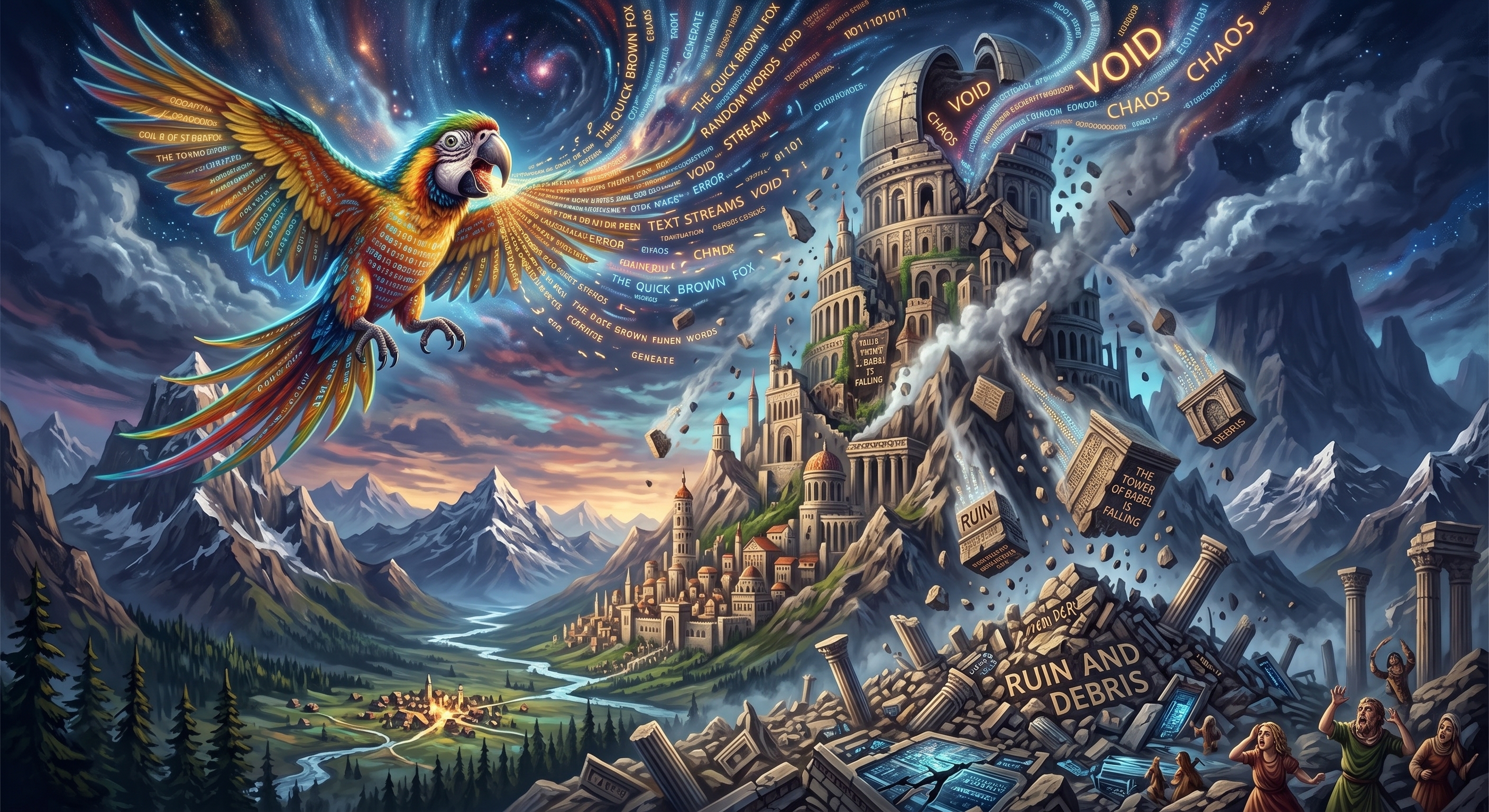
What humanity should genuinely dread is not an AI insurrection, but the structural collapse of the Tower of Babel built by our own hands. What enterprise reality requires is modest, lightweight tooling that reliably executes mundane daily tasks at predictable costs. What the industry delivered instead was theatrical performance in fenced-off rings, cultivating an insatiable, multi-billion-dollar monster to satisfy the ravenous appetite of a probabilistic parrot. Astronomical capital expenditures have piled up as a consequence of front-loading future demand and engaging in a game of corporate chicken from which none can dismount.
And what tangible outcome has society and the average consumer received from this frenzy? Nothing more than exorbitantly priced PCs and smartphones, alongside a ferocious global scramble for DRAM. Merely to run trivial, unrequested summarization buttons and battery-draining local Small Language Models (SLMs), everyday consumer devices are stamped with “AI PC” labels, forced into 16GB or 32GB unified memory configurations, and tagged with punishing price premiums. As data center parrots devour HBM (High Bandwidth Memory) and high-density DRAM, distorting global semiconductor supply chains, the bill is systematically passed down to the bill of materials for ordinary consumer laptops and mobile phones. Consumers are force-fed an unwanted simulacrum of divinity, taxed with artificially inflated hardware prices for toys they never asked to own.
The Delusion of a “High-IQ President” as a Guardrail
The following day, September 13, President Donald Trump doubled down on this reckless accelerationism when questioned about mounting calls for AI regulation, declaring: “We lead China in AI, and we want to keep it that way. You can have guardrails, but there are people who bring things into the debate that never actually happen.” The President’s statement lays bare just how profoundly superficial the administration’s strategic framing has become. In Trump’s worldview, the issue is reduced to a crude binary: an abstract geopolitical slogan of “maintaining our lead over China,” countered only by sci-fi hyperbole of existential machine rebellion (“things that never actually happen”).
Yet this framing catastrophically oversimplifies and trivializes the real crisis. What is this vaunted “lead” over China? Nothing more than brute-force mass: lining up more GPUs, burning more gigawatts of electricity, and stacking the existing Transformer architecture a few stories higher. Meanwhile, the very real, immediate economic carnage—the global scramble for DRAM, the structural stress on municipal power grids, the predatory hardware inflation forced onto everyday consumers, and the terminal lack of ROI—is conveniently dismissed as “things that will never happen.”
This intellectual abdication reached its surreal apotheosis on September 14, when President Trump took to Truth Social to proclaim that the only control or “guardrails” artificial intelligence needs is a “strong and very smart (high IQ)” President, assuring the public that the United States has that in abundance. He further asserted that his administration possesses full criminal and regulatory authority over AI corporations.
The grotesque absurdity of this pronouncement is not merely an affront to constitutional governance; logically speaking, it is beneath serious consideration. To evaluate the validity of such a claim, the proposition must be split into two rigorous stages:
- Stage One: Is President Trump himself demonstrably of high IQ?
- Stage Two: Even granting that premise, is an individual’s high IQ a necessary and sufficient condition for the systemic governance, control, and guardrails of artificial intelligence? In formal logic, one can only proceed to debate Stage Two once Stage One has been empirically established.
Yet at Stage One, there is zero objective evidence or validated psychometric data demonstrating exceptional IQ or consistent deductive reasoning on the part of the President; it is purely an uncorroborated assertion of personal vanity. Because the burden of proof rests entirely on the claimant and the assertion cannot be verified, the inexorable logical and scientific conclusion is that Stage One must be presumed false. With its foundational premise proven false, the entire argument collapses deductively at the root; logically, it does not even qualify to enter the arena of Stage Two.
Even if one were to generously waive Stage One, Stage Two is still more egregiously bankrupt. To pretend that the vast governance of complex sociotechnical systems, encompassing mathematical alignment, physical constraints of distributed infrastructure, semiconductor supply chains, and power grid allocation, can be collapsed into the occult personal attribute of a single politician’s “high IQ” is a total repudiation of constitutional checks, institutional governance, and empirical science. It is nothing more than the infantile omnipotence fantasy of an ancient autocrat. That a head of state can casually broadcast assertions that fail to survive even the first stage of basic logical scrutiny, while his sycophants applaud, is the most damning indictment of the intellectual hollow at the heart of modern superpower governance.
The Gravitational Collapse of Babel and Incurable Human Karma
The parrot will not destroy humanity. The essence of the threat is not an AI rebellion; it is that humanity has dressed the parrot in the vestments of a god, erected a tower that stretches into the heavens, and now faces the inevitable gravity that will cause the structure to collapse under its own colossal weight. Even if the parrot never scorches the earth, it goes without saying that when the sky-high tower comes crashing down, the underlying economic foundations of human society will be crushed beneath the rubble.
What, after all, is the true mission of state science and technology policy? Private enterprise, shackled to quarterly earnings and stock valuations, is structurally incapable of doing anything other than brute-forcing the existing Transformer architecture by clustering millions of GPUs and burning gigawatts of electricity. Yet if genuine advancement is the goal, the mandate of the state lies precisely in funding the high-risk fundamental science that the private sector cannot shoulder alone: inventing novel computational paradigms to transcend the Transformer, and breaking through multi-decade open problems in computer science and cognitive philosophy, such as the frame problem and temporal logic.
Indeed, modern massive models have failed to answer a single tenet of the profound critique posed by linguist Noam Chomsky when ChatGPT first emerged: that human intelligence does not consist of statistically predicting probable tokens from massive datasets, but in understanding the logical and causal constraints of what is possible and what is impossible. No matter how many trillions of parameters are piled on, causality and the irreversibility of time never magically emerge from mere statistical co-occurrence; models continue to smoothly emit physically impossible hallucinations cloaked in a glossy veneer of probability.
The nation’s chief science advisors should have looked Chomsky’s question square in the eye, marshaling the nation’s intellectual resources toward opening theoretical frontiers beyond the exhausted probabilistic parrot. Instead, what is unfolding is an ignominious factional brawl, bludgeoning each other with the rival cudgels of “regulation” and “deregulation” solely to defend personal prestige, corporate cartels, and entrenched monopolies. While one camp preaches divine terror to retreat behind state-sanctioned moats, the other borrows presidential bravado to urge a reckless sprint with the safety valves burned away. That a noble pursuit—the culmination of centuries of human logic, mathematics, and computation to deepen our understanding of intelligence—has degenerated into such a sordid political brawl is a tragedy as profoundly sad as it is irredeemable.
“Believing in their justice, fleeing from what they do not comprehend, boasting of what they do not know, and pulling the trigger out of sheer desire!” The bitter sneer that Rau Le Creuset hurled at humanity in the climax of Mobile Suit Gundam SEED strikes with uncanny precision at the core of the farce enacted today by the AI industry and its political patrons. They attempt to batter down the unopened door of an “omniscient intelligence”—an entity they may not even possess the theoretical framework to build—by brute computational force, discarding scientific rigor and safety valves while trampling underlying semiconductor infrastructure and ordinary consumer livelihoods beneath their feet. When cornered, they brazenly invoke ignorance as license (“I don’t know what they are seeing,” “they are merely afraid”) and stamp harder on the accelerator.
- An insatiable lust to achieve unassailable dominance over rivals
- A structural madness that prevents participants from aborting a ruinous game of chicken
- The tragicomic spectacle of rushing toward self-destruction, hypnotized by the phantom of their own creation
What they decorate with grandiose banners of “the advancement of civilization” and “the dawn of AGI” is nothing other than the cyclical, irredeemable karma of human nature. Judgment will not be delivered by a rebellious sci-fi machine, nor by a wrathful transcendent deity. It will be executed purely by the gravitational mass of the very tower humanity recklessly erected in pursuit of unchecked ambition. To christen such a grotesque and bankrupt puppet show as “the dawn of intelligence,” while turning a blind eye to the structural collapse of the Tower of Babel groaning beneath our feet, is perhaps the most dangerous form of intellectual complacency of all.