
The ZDNET Japan article titled “Linux on Desktop market share exceeds 10% – nearly doubling in one year” has a major flaw. The underlying data for this article has already been called into question by other media outlets. For instance, CNET’s article “Linux traffic spikes in North America: Why?” captures the core issue brilliantly, including its headline—accurately identifying “Linux traffic spikes in North America” as the fundamental cause behind the metric shift.
Reading the CNET article quickly reveals the underlying mechanics behind the surge.
Lai Yi Ohlsen, a senior product manager at Cloudflare, explained in an email response to CNET that according to Cloudflare data measuring HTTP requests by operating system, Linux accounted for 9.8% of internet traffic originating from North America between July 4 and August 1. This closely matches Statcounter’s metrics.
Looking at the original StatCounter chart makes the situation even clearer:
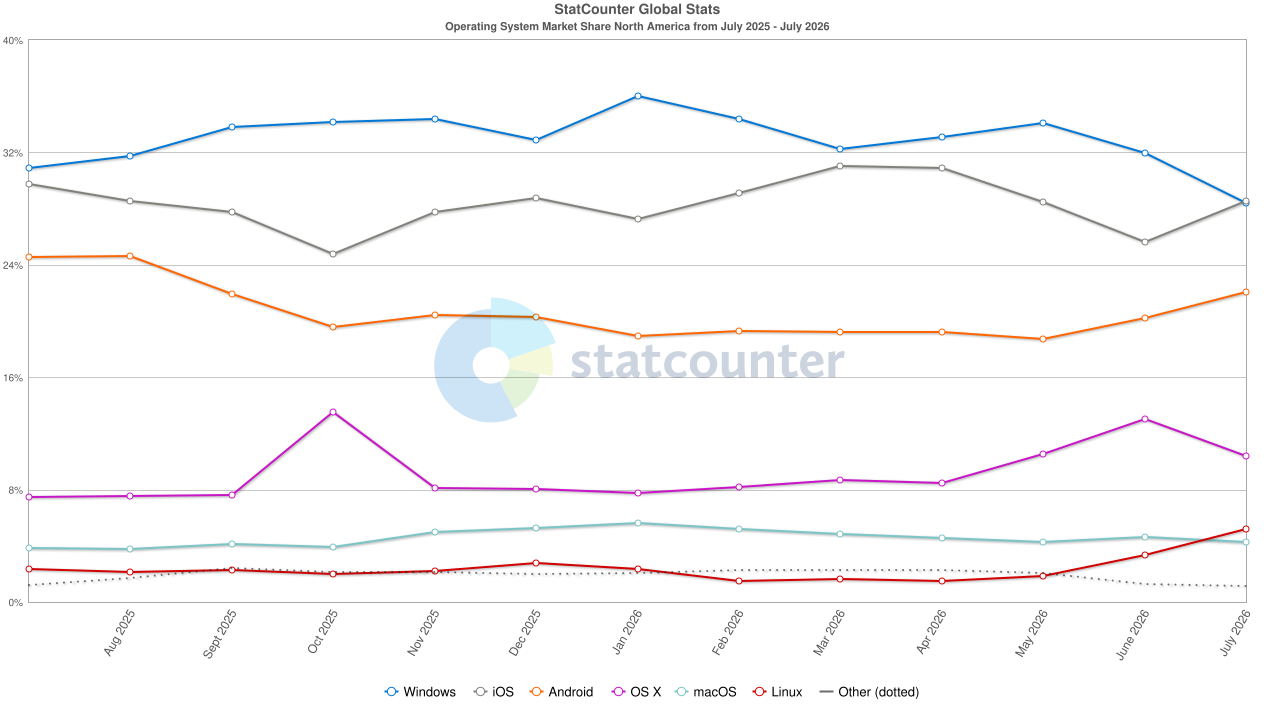
Examining the red line for “Linux”, it sits flat at the bottom around 1–2% from July 2025 to around April 2026. Then, starting in May 2026, it ascends at a steep angle, suddenly jumping to over 5–6% in July. It is physically impossible for actual end-user behavior to transform so drastically in just a few months. To any objective observer, this is a textbook anomaly caused by noise, such as automated bot traffic.
In short, it is reasonable to conclude that a surge in automated bot traffic is the true culprit behind the spike in Linux numbers.
Here, one must pay close attention to the author of the original article, Steven J. Vaughan-Nichols (SJVN). He is a veteran columnist and prominent writer in the open-source and Linux communities, widely known as a die-hard desktop Linux advocate—someone who proclaims every coming year as the “Year of Desktop Linux.”
For him, a “decline in Windows share” and a “breakthrough for Linux” represent a long-cherished dream he eagerly wants to prove. Consequently, when an anomaly (noise) appeared in the StatCounter dataset, rather than applying rigorous data science checks like cross-validation or outlier detection, he jumped on it as convenient proof supporting his bias, hailing it as “the time has finally come!”
As a veteran writer, he fully understands that counterarguments pointing out StatCounter’s inherent biases are inevitable. Hence, he proactively embeds disclaimers regarding StatCounter’s limitations into his article, building a defense wall against incoming criticism—all while keeping his core conclusion (“Linux’s doubling is remarkable!”) completely intact.
Blind Compliance by the Japanese Edition (ZDNET Japan / Asahi Interactive)
In US ZDNET, SJVN is a prominent columnist whose articles command high readership. That is likely why the Japanese editorial desk simply translated and published his piece without fact-checking or adding translator notes, driven by the mindset of “SJVN wrote it” and “it makes a clickworthy headline.”
Figures don’t lie, but liars do figure.